
Microbiological Safety Cabinets
Microbiological Safety Cabinets are used to provide protection to the operator, the environment, and the product while handling dangerous biological materials. It is important to differentiate between conventional Unidirectional Air Flow systems (formerly known as Laminar Air Flow or LAF) and Microbiological Safety Cabinets.
Unidirectional Air Flow systems provide a particulate-controlled atmosphere for critical operations but do not offer protection to the operator or the environment. In contrast, Microbiological Safety Cabinets are designed to ensure operator safety, environmental protection, and product protection.
The selection of a Biological Safety Cabinet depends on the type of biologically hazardous material handled inside the cabinet. Various international organizations have defined biological risk classifications based on the pathogenic nature of biological materials and the minimum safety requirements needed to protect personnel, the environment, and materials during handling.
Major organizations involved in developing pathogen classification and safety guidelines include the Dangerous Pathogens Advisory Group (DPAG) and the Department of Health and Social Security (DHSS), Great Britain; the Centers for Disease Control (CDC), USA; the World Health Organization (WHO); the National Cancer Institute (NCI), USA; and the National Institutes of Health (NIH), USA.
Classification of Microbiological Safety Cabinets
Different countries have adopted various standards and specifications for this equipment, but the following standards are generally accepted worldwide:
- NSF/ANSI 49 -2002 (National Sanitation Foundation, USA)
- EN 12469 -2000 (European Standard)
- AS 2252 -2004 (Australian Standard)
Microbiological Safety Cabinets are divided into Basic 3 Classes
| Function | Class I | Class II | Class III |
|---|---|---|---|
| Operator protection | Good | Good | Excellent |
| Environmental protection | Good | Excellent | Excellent |
| Product protection | None | Excellent | Poor |
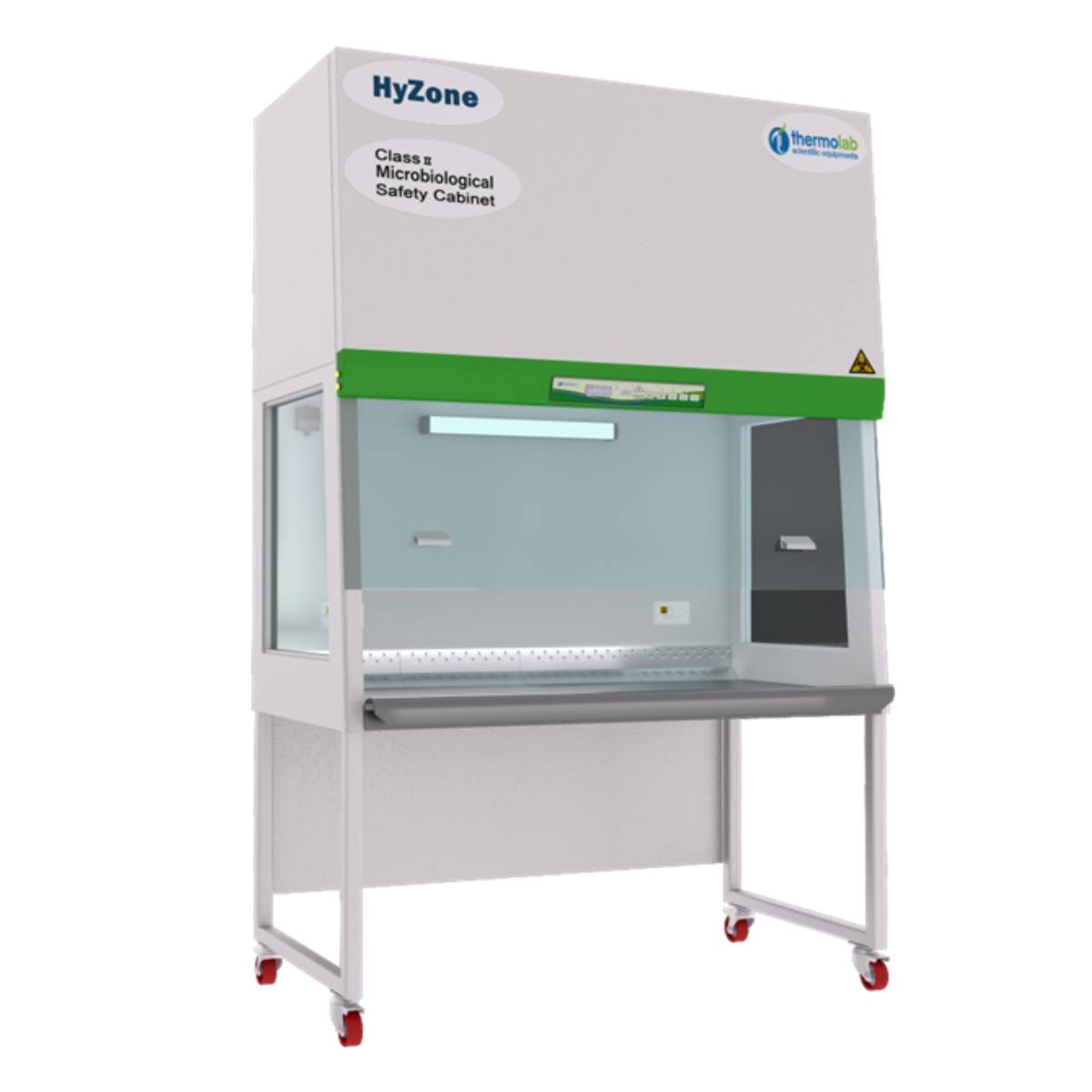
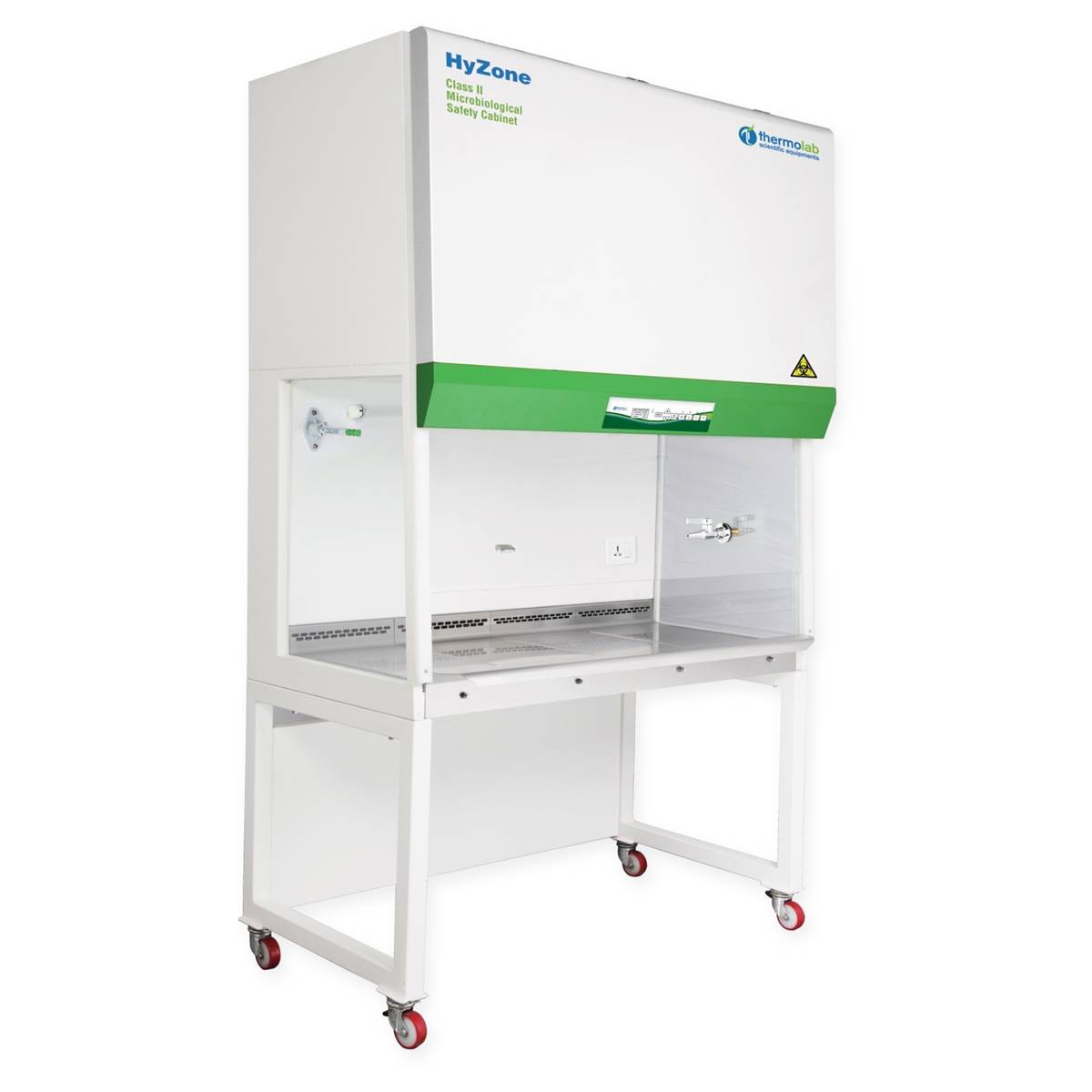
HyZone Class II Microbiological Safety Cabinets
HyZone Class II Microbiological Safety Cabinets from Thermolab blend knowledge, experience and innovative design changes in creating state – of – the – art equipment as part of its offerings. HyZone is a Class II Microbiological Cabinet, designed and built to meet, if not exceed, performance requirements of the EN 12469:2000 Standard. 70% air is re-circulated through the main H14 HEPA Filter within the cabinet, while the remaining 30% is exhausted through two H14 HEPA filters in series.
HyZone Cabinets are suitable for handling microorganisms and pathogens as defined by the appropriate International Standards, current health and safety guidelines and legislation aimed at safeguarding health and safety of operators at work. 95 % of your requirements are met by Class II A2 Cabinets.
However, Class I and Class III cabinets can be manufactured if your work so warrants.
HyZone Class II Cabinets are available in 3 types:
| Class | Exhaust Air % | Recirculated Air % | Exhaust Connection |
|---|---|---|---|
| II A2 | 30 | 70 | Into Room/Loose Connected to exhaust duct |
| II B1 | 70 | 30 | Ducted out of Room |
| II B2 | 100 | 0 | Ducted out of Room |
General Specification of HyZone Class II Microbiological Safety Cabinets:
| Model | A2003 | A2004 | |
|---|---|---|---|
| Work table width | 0.9 m (3′) | 1.2 m (4′) | |
| External Dimensions (W x D x H) | Without Base Stand | 1035 x 800 x1470 mm | 1340 x 800 x 1470 mm |
| With Base Stand, 711mm | 1035 x 800 x 2181 mm
982 x 563 x 670 mm |
1340 x 800 x 2181 mm
1270 x 563 x 670 mm |
|
| Internal Work Area Dimensions (W x D x H) | |||
| Average Airflow Velocity | Inflow | 0.45 m/s (90 FPM) +/- 20% | |
| Downflow | 0.30 to 0.45 m/s (60 to 90 FPM) with uniformity of better than +/- 20% | ||
| HEPA Filter Typical Efficiency | Downflow | >99.997% at 0.3 micron, H 14 as per EN 1822 | |
| Exhaust | |||
| Noise level | Cabinet | <62 dBA at 45 dBA ambient | <62 dBA at 45 dBA ambient |
| Fluorescent Light Intensity | >1200 Lux | >1200 Lux
(>100 foot candles) |
|
| Cabinet Construction | Main Body | 1.2 mm (0.05″) 18 gauge steel with powder-coated finish | 1.2 mm (0.05″) 18 gauge steel with powder-coated finish |
| Work table | 1.5 mm (0.06″) 16 gauge stainless steel, type 304, | 1.5 mm (0.06″) 16 gauge stainless steel, type 304, | |
| Side Walls | UV absorbing tempered glass, 5 mm (0.2″), transparent | UV absorbing tempered glass, 5 mm (0.2″),transparent | |
| Electrical | 220-240V, AC, 50Hz, 1 Ф | ||
| Cabinet Power/ Amp | 450 W / 2.5 AMP | 500 W / 3 AMP | |
- Independent blowers for Supply and Exhaust air
- Double HEPA filtration of Exhaust air
- Negative pressure envelope (shroud) for HEPA filter Plenums and Return air path to prevent escape of Contaminated air to atmosphere and work area
- Simultaneous real time monitoring and display of Supply and Exhaust air velocities
- Monitoring of work area temperature
- Sliding front sash with counter weights for easy operation
- Microprocessor controlled operations with Normal, Fast Start and Service modes and alarms
- Ergonomic design like angled front sash, arm rest , for operator comfort
- RS 232 connectivity
- EN 12469:2000 compliant
Soft Touch Keyboard
Membrane touch keyboard and the rear-lit LCD display all required data keeping the operator constantly up to date of the cabinet condition
- Estimated life of HEPA filters
- Estimated life of UV lamp
- Cabinet Temperature
- Laminar airflow (Unidirectional Down Flow) velocity and frontal air barrier (in flow) velocity
- Front sash position
Audio Visual alarms are provided for:
- Out of range or incorrect laminar airflow velocity and frontal air barrier velocity
- Incorrect position of front sash-window
- Clogging of HEPA filters
- End of life-cycle of UV Lamp
- Out of range temperature
- Microbiology
- Pathology
- Stem Cells Research
- Medical Devices
- Cell culture
- Reconstitution of Parenteral drugs
- Virology
- Blood Bank
- Biotechnology
- Pharmaceuticals
- Recombinant – DNA
- Genetics.
- Haematology
- Eye Bank